
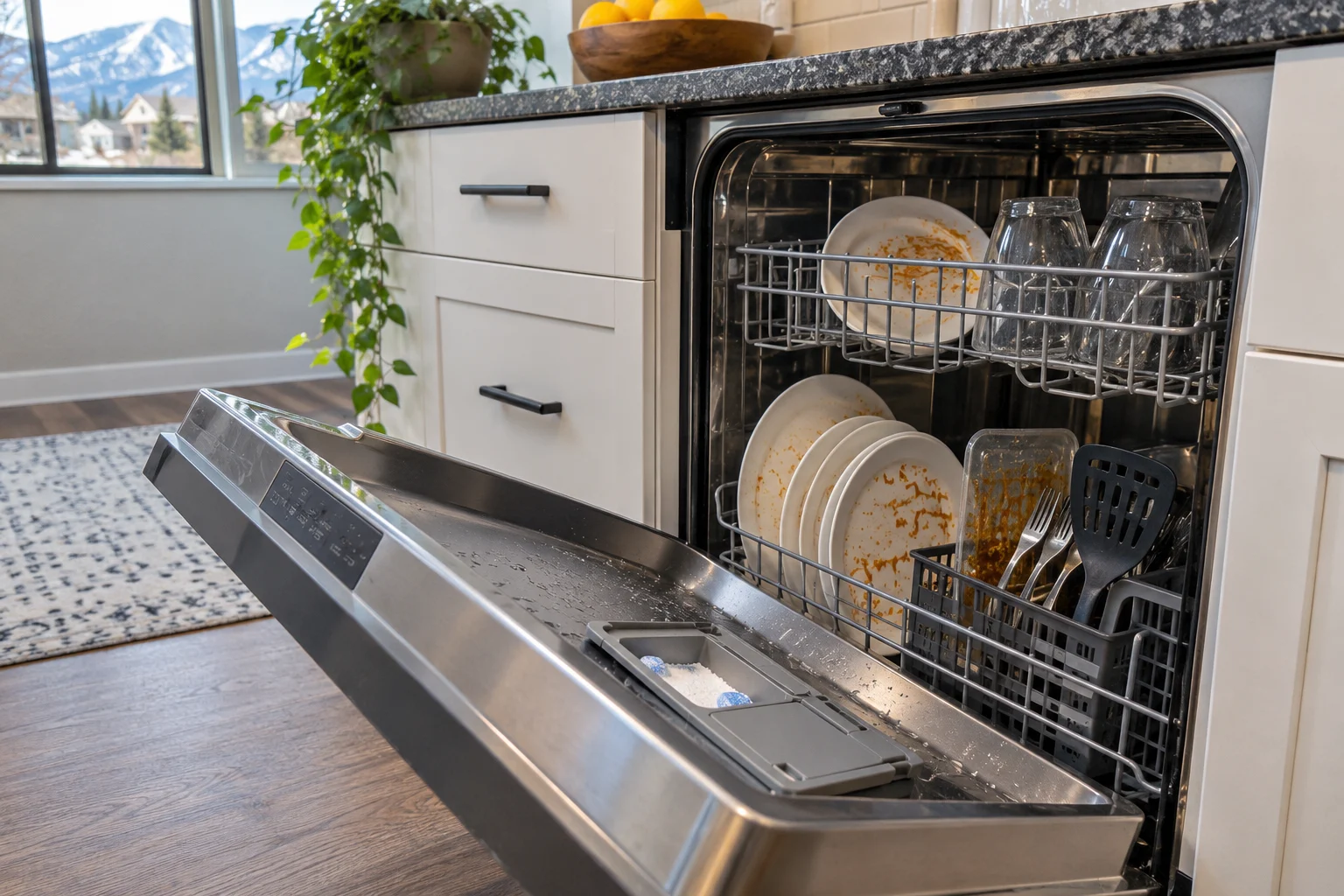
Your dishwasher starts washing like normal, but somewhere in the middle of the cycle, it stops. Maybe the display goes dark, maybe the machine goes quiet and never starts again, or maybe you open the door later and find dirty dishes with detergent still sitting in the dispenser.
It’s frustrating because the dishwasher clearly can start. You might even restart it and hear water spraying again, only to have it stop halfway through the next attempt. Now you’re wondering whether something simple interrupted the wash or whether a part is starting to fail.
When a dishwasher stops mid cycle, possible causes include a door that isn’t staying latched, an interruption in power or water supply, a drainage problem, or an issue with the appliance’s controls or internal components. The important thing is figuring out what happens when it stops before assuming which part needs attention.
Here’s what to look for, what you can safely check yourself, and when the problem needs a closer look.
Why Does a Dishwasher Stop in the Middle of a Cycle?
A dishwasher doesn’t run the same way from beginning to end. It fills with water, sprays the dishes, drains, and moves through different washing and rinsing stages. Some models also pause while water heats to the required temperature.
That means a few moments of silence aren’t necessarily a problem. But if your dishwasher stops halfway through a cycle and never finishes, something may be interrupting the process.
Several problems can cause this behavior.
1. The Door Isn’t Staying Properly Latched
Your dishwasher has a door safety mechanism that prevents it from operating when the door isn’t securely closed. If the latch doesn’t engage correctly, the machine may refuse to start or pause during a wash cycle.
Sometimes the issue is simpler than a broken latch. A tall pan, oversized cutting board, or poorly positioned dish rack may prevent the door from closing completely. The dishwasher might appear closed even though it isn’t properly secured.
If the door closes normally but the machine keeps acting as though someone opened it, the latch or door switch may need professional attention. Don’t try to bypass the safety mechanism or force the door shut.
2. Power Is Being Interrupted During the Wash
If your dishwasher shuts off during the wash cycle and the entire control panel goes dark, pay attention to whether it has lost electrical power.
A tripped breaker, loose plug where accessible, or another electrical supply problem could interrupt operation. Depending on the model, an internal electrical or control issue could also cause the dishwasher to shut down unexpectedly.
There’s an important difference between a dishwasher that pauses while the display remains on and one that completely loses power. That distinction can help narrow down the problem before anyone starts testing components.
3. Something Is Interrupting the Water Supply
Your dishwasher needs water at different points throughout its cycle. If it cannot fill properly when required, some models may pause, stop, or display an error message rather than continue washing.
A partially closed water supply valve, inadequate incoming water, or a problem with a water-related component could be involved.
Check whether your kitchen sink has normal water flow and whether the dishwasher’s accessible water supply valve is open. If those appear normal but the dishwasher still stops during a fill stage, the problem may require further diagnosis.
4. The Dishwasher Is Having Trouble Draining
Some dishwashers stop progressing through their cycles when water isn’t draining the way it should. You might notice water remaining in the bottom of the tub, an error message, or unusual sounds around the time the dishwasher should be emptying.
The issue could involve a blocked filter, restricted drain path, or a drain-related component. However, finding water inside a dishwasher that stopped early doesn’t automatically mean the drain pump is broken.
If water remains in the tub, our guide to dishwasher draining problems and troubleshooting explains the signs worth checking. The key here is determining whether the dishwasher stopped because it couldn’t drain or whether water remained simply because the wash cycle was interrupted.
5. A Control or Internal Component Is Malfunctioning
Sometimes the door is secure, the power stays on, and the water supply appears normal, but the dishwasher still won’t finish its cycle. That can point toward an issue with the controls, a sensor, a pump motor, or another component involved in the washing process.
An intermittent problem can be particularly confusing because the dishwasher may work for part of a cycle before stopping again. The timing may provide clues, but it isn’t enough to identify a failed component on its own.
A dishwasher that repeatedly stops at the same stage needs a diagnosis, not a guess about which part to replace.
What Happens Right Before Your Dishwasher Stops?
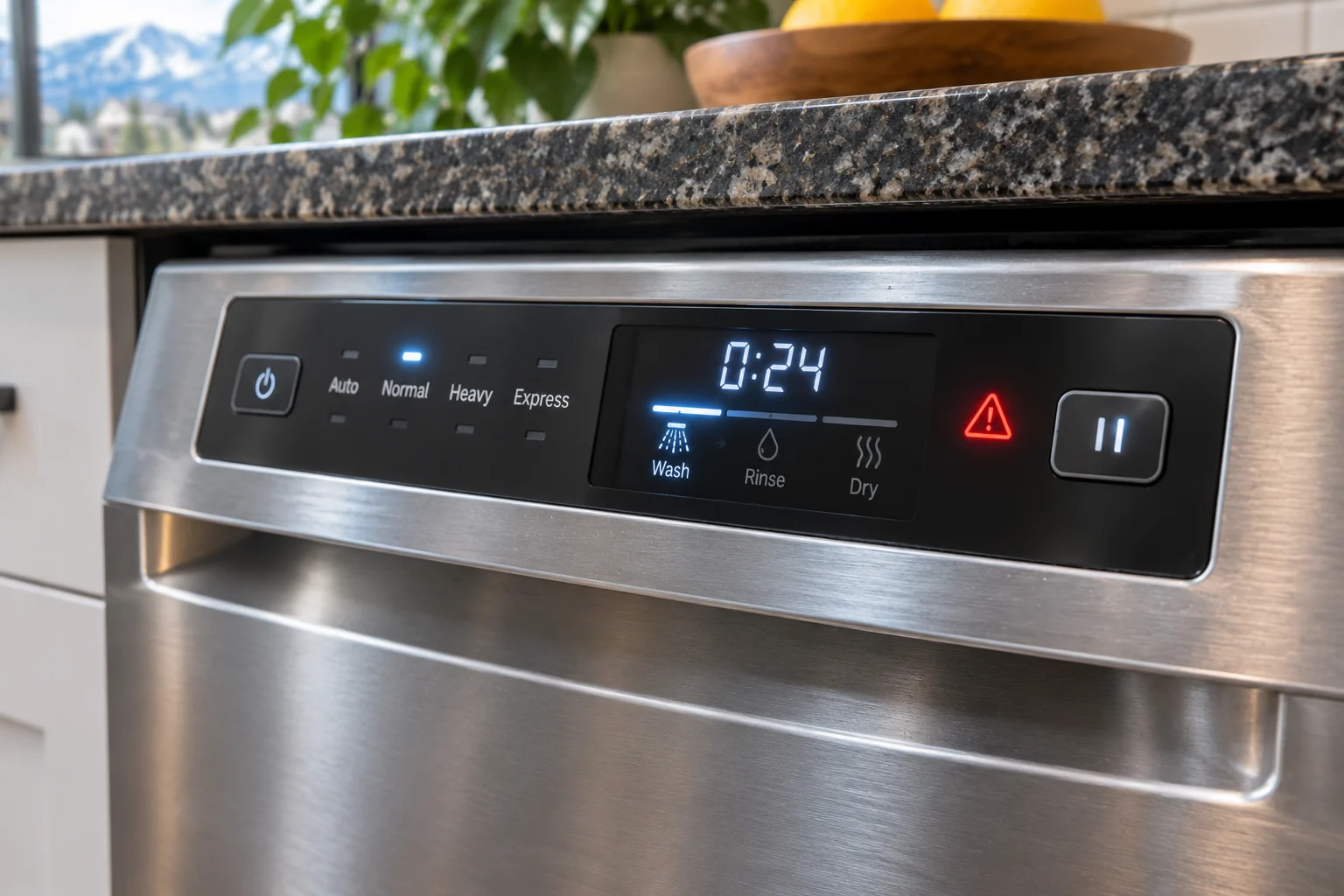
Before restarting the dishwasher, pay attention to what it was doing when the interruption happened. These details are often more helpful than simply reporting that the dishwasher stopped working.
The Display Goes Completely Dark
If the dishwasher loses all its lights and display information, an interruption in electrical power is one possibility. Check whether other appliances or outlets nearby are affected and whether a breaker has tripped.
If the breaker trips again, don’t repeatedly reset it to keep the dishwasher running. Leave the appliance off and have the electrical issue evaluated.
The Display Stays On, but Washing Stops
If the control panel remains active, look for a flashing Start or Resume indicator, a pause message, or another status light.
On some dishwashers, opening the door during a cycle requires you to press Start or Resume before closing it again. Other models may resume differently, so the instructions in your owner’s manual matter.
An Error Code Appears
An error code is useful information, even if you don’t understand what it means. Write it down or take a photo before clearing anything from the display.
Different manufacturers use different error codes, and the same symptom can have more than one possible cause. Check the code against your specific model’s manual rather than following instructions intended for a different dishwasher.
Water Remains Inside the Dishwasher
If the dishwasher stops mid cycle with water inside, look at how much water is present and whether the machine was supposed to be draining at that point.
Water in the tub during an unfinished wash isn’t necessarily abnormal. However, water that won’t drain, especially when accompanied by an error code or unusual pump noise, deserves additional attention.
The Dishwasher Goes Quiet but Eventually Starts Again
Some dishwashers pause during normal operation, including when they’re waiting for water to heat. Whirlpool explains this behavior in its dishwasher cycle troubleshooting guidance.
If the appliance resumes on its own and eventually reaches the end of the cycle, it may be working as designed. If it remains stuck indefinitely or repeatedly fails to finish, that’s a different situation.
What Can You Safely Check Before Calling for Repair?
You don’t need to remove electrical panels or take apart your dishwasher to gather useful information. A few basic checks may help you identify an interruption that can be corrected without replacing anything.
Start with these steps:
-
Check the dishwasher door. Make sure nothing inside is preventing it from closing. Look for large dishes touching the door, racks that aren’t fully pushed in, or visible debris around the latch area.
-
Look at the control panel. Check for a Pause, Delay Start, or other active setting. If a light is flashing, refer to your owner’s manual to see whether the dishwasher is waiting for a command.
-
Confirm the appliance has power. If the display is completely dark, check the household breaker and any safely accessible plug. Don’t attempt electrical testing or work inside the appliance.
-
Check the water supply. Confirm that the kitchen sink has water and that the dishwasher’s accessible shutoff valve hasn’t accidentally been closed.
-
Look for visible water or leaks. Check around the floor and base of the dishwasher. If there is water leaking onto the floor or into the cabinets, stop using the appliance.
-
Follow your model’s restart instructions. If there are no warning signs, use the manufacturer’s instructions to resume or reset the dishwasher. Procedures vary, and some models require a particular button sequence.
Bosch also recommends checking the door, power and water supply, and dish loading when a dishwasher stops unexpectedly. You can review its official dishwasher troubleshooting guide for additional manufacturer guidance.
If a simple setting or an improperly closed door caused the interruption, correcting it may be enough. If everything appears normal but the dishwasher stops again, don’t keep repeating the same troubleshooting steps without learning anything new.
Why Does the Dishwasher Keep Stopping After You Restart It?
A restart can sometimes get a dishwasher moving again, but that doesn’t mean the original problem has been resolved. If the same interruption keeps happening, something may still be preventing the machine from completing a particular stage.
For example, a dishwasher might wash normally at first but stop when it needs to drain. Another might lose power intermittently, while one with a door-latch issue could pause when the door shifts slightly during operation.
Pay attention to whether the dishwasher stops at roughly the same point every time. If it consistently quits after 15 or 20 minutes, that timing is worth mentioning when you call for help, even though it doesn’t identify a specific failed part.
If one manufacturer-approved restart doesn’t solve the problem, continuing to restart the dishwasher over and over isn’t the best approach. You may only be repeating an unfinished cycle while the underlying issue remains.
When Should You Stop Using the Dishwasher?
Not every dishwasher interruption is dangerous, but certain warning signs mean you should stop trying to finish the wash cycle.
A dishwasher that won’t complete a cycle needs more immediate attention if you notice:
-
Water leaking onto the floor or into nearby cabinets. Turn off the water supply if you can safely reach the valve.
-
A burning smell, smoke, or signs of overheating. Stop using the dishwasher and disconnect power only if you can do so safely.
-
A breaker that repeatedly trips. Don’t keep resetting it to force the appliance to operate.
-
Unusual grinding, banging, or other concerning mechanical sounds. Stop the cycle rather than allowing the machine to continue struggling.
-
Repeated errors or failed restarts. If the dishwasher consistently cannot finish, further attempts may not provide any useful information.
If there’s standing water near an electrical connection, don’t touch the dishwasher, plug, or wet electrical components. Have the situation evaluated before using the appliance again.
Also, avoid trying to access wiring, bypass the door switch, or replace internal components based on an online symptom checklist. Those repairs require proper testing and an understanding of the appliance’s electrical and mechanical systems.
When to Call iFiX Appliance Repair

If your dishwasher starts normally but repeatedly stops before the cycle finishes, it’s time to find out what’s interrupting it. You shouldn’t have to stand in the kitchen restarting the same load and hoping it makes it through this time.
At iFiX Appliance Repair, we help Northern Utah homeowners troubleshoot appliance problems and determine when professional diagnosis makes sense. That includes dishwashers that unexpectedly shut off, pause without resuming, display errors, or fail to complete their wash cycles.
When you call, it helps to have a few details ready:
-
The dishwasher brand and model number, if available
-
Whether it stops after a few minutes or later in the cycle
-
Whether the display stays on or goes completely dark
-
Any error codes or flashing indicator lights
-
Whether water remains inside after the interruption
-
What you’ve already tried, including any restart attempts
You don’t need to know which component is failing. Explaining what happens before the dishwasher stops gives our technician a useful starting point for diagnosis.
We provide dishwasher repair services in Ogden and surrounding Northern Utah communities, including Layton, Roy, Clearfield, and nearby areas. Our goal is to identify the actual issue and explain the recommended repair before work begins.
Clear Next Steps If Your Dishwasher Won’t Finish a Cycle
If your dishwasher has stopped unexpectedly, start by checking whether the door is closed securely, whether the controls show a pause or error message, and whether the appliance still has power and water. If there are no safety concerns, follow your owner’s manual for resuming or resetting the cycle.
If the dishwasher completes a normal cycle afterward, keep an eye on it for another interruption. If it stops again, especially at the same point, write down what happened rather than repeatedly trying to restart it.
A dishwasher stopping in the middle of a cycle doesn’t automatically mean a major repair is needed. But when the same problem keeps returning, an accurate diagnosis is the best way to determine what needs attention.
If you’re dealing with a dishwasher that won’t finish washing, call iFiX Appliance Repair at (801) 731-4349. Describe what happens during the cycle, and we’ll help you determine the next step.
Frequently Asked Questions About Dishwashers Stopping Mid-Cycle
Do I need to wash the dishes again if the dishwasher stopped before finishing?
Yes. If your dishwasher stopped before completing its wash and rinse stages, you shouldn’t assume the dishes are properly cleaned. Some may still have food residue or detergent on them, even if they look reasonably clean.
Once the dishwasher is working correctly, run a complete wash cycle again. Avoid relying on a partially completed cycle, especially for dishes used to prepare or serve food.
How can I tell whether my dishwasher actually finished its cycle?
Many dishwashers display a Clean or End indicator, show a completed cycle time, or sound a notification when washing is finished. The exact signal depends on the brand and model, so checking your owner’s manual is the best way to confirm what a completed cycle should look like.
Don’t assume the cycle is finished simply because the dishwasher has gone quiet. Some models pause between washing stages, while others may stop unexpectedly without displaying a completion message.
What should I do if detergent is still sitting in the dispenser after the dishwasher stops?
First, check whether the detergent dispenser door is still closed or whether it opened but left detergent behind. A closed dispenser could mean the dishwasher stopped before releasing the detergent, although a blocked or malfunctioning dispenser is another possibility.
If the dispenser opened but detergent remains, the dishwasher may have experienced an interruption or a washing-related problem. Check for dishes obstructing the dispenser, and avoid adding more detergent until you’ve determined whether the appliance can complete a normal cycle.
Will my dishwasher resume where it left off after a power outage?
Some dishwashers can resume an interrupted cycle when power returns, while others require you to press Start or Resume again. Certain models may cancel the interrupted program entirely, meaning you’ll need to begin a new cycle.
Check the display and follow your model’s instructions after power is restored. If the dishwasher repeatedly loses power during normal operation, don’t assume it’s simply a temporary interruption, especially if a circuit breaker keeps tripping.
Call (801) 731-4349 or book online. Same-day appointments available.